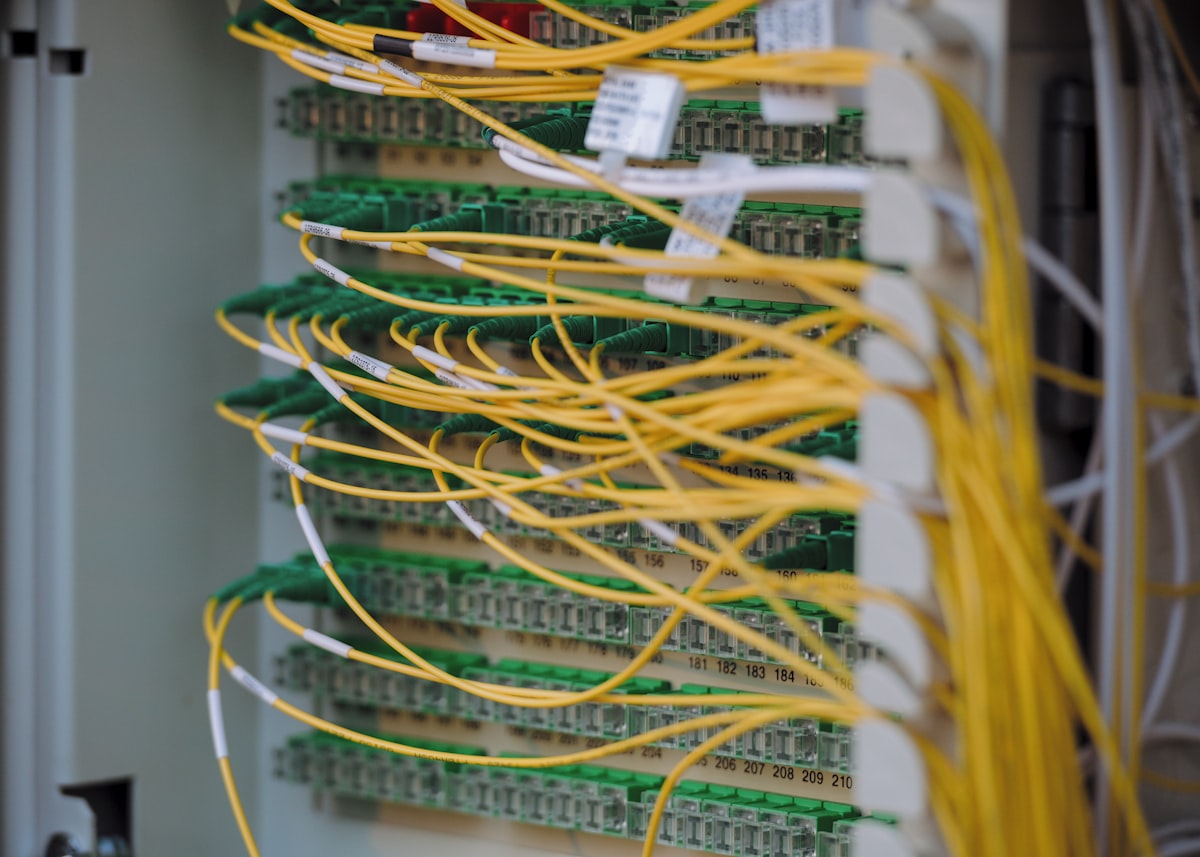
In the late 1990s, telecom companies buried enough optical fiber under the United States to wrap the planet many times over, and then lit almost none of it. A lot of the gear went out on credit from the people who made it: Lucent and Nortel lent their own customers the money to buy Lucent and Nortel equipment, which made the order books look magnificent right up until they didn't. When the traffic that was supposed to fill all that glass failed to show up on schedule, Global Crossing and WorldCom collapsed, the accounting turned out to be fiction, and the cable sat dark in the ground. Then, about a decade later, streaming video and the cloud arrived and used it. The capital was incinerated. The infrastructure survived.
I keep that story close because both sides of the current argument tell it, and they walk away with opposite lessons. To one camp, the dark fiber is the whole warning: a mania funded by vendors laying pipe for demand that has not arrived ends in bankruptcies and stranded assets, and the people cheering are the ones selling the pipe. To the other, it is proof that even a bubble leaves something useful behind, and that the accountants counting the wreckage always miss the part where the wreckage gets put to work. Same fiber. Two films.
The question of whether artificial intelligence is a bubble has quietly stopped being the interesting one, because nearly everyone now answers yes to some version of it. Sam Altman said last summer that the market is in a bubble. Mark Zuckerberg, as CNBC reported, allowed that an AI bubble was possible and then added that he would rather see his company misspend a couple hundred billion dollars than be late to superintelligence. What they disagree about is the adjective. Is this a financial bubble, the sort that wipes out savers and drags the real economy down with it, or an industrial one, the sort that overbuilds and leaves cheap capacity behind? And underneath that: whether the revenue is coming, and when. What follows is the honest state of the argument, both sides built as strongly as I can build them, because after a month of reading I can make a convincing case either way, and by the end you should be able to as well.
The case for calm: the revenue is real
Start with the strongest version of "not a bubble," because the skeptics tend to skip past it too fast. The revenue is real, and it is large, in a way it simply was not in 1999. OpenAI was running at roughly a $25 billion annualized rate by mid-2026, up from around $3.7 billion in 2024, according to figures reported by The Information, with something like 800 million weekly users. Anthropic said in April, in figures it disclosed and Bloomberg reported, that its run-rate had crossed $30 billion, up from about $9 billion at the end of 2025, the first time its run-rate topped OpenAI's. Nvidia is booking data-center revenue in the tens of billions per quarter. These are people paying money for a product, not eyeballs and page views dressed up as a business model. Larry Fink of BlackRock has called the capital being deployed "well spent." Howard Marks of Oaktree, no one's idea of a hype man, has described valuations as high but not crazy.
The bull case has an intellectual spine, too, and it belongs to a dead Victorian economist. In January 2025, when the Chinese lab DeepSeek showed you could match a frontier model for a fraction of the cost and the market briefly panicked, Satya Nadella posted on X: "Jevons paradox strikes again! As AI gets more efficient and accessible, we will see its use skyrocket, turning it into a commodity we just can't get enough of." William Stanley Jevons observed in 1865 that more efficient steam engines did not reduce Britain's coal consumption; they increased it, because cheaper power got used everywhere, and consumption tripled by 1900. The claim is that intelligence works the same way. Make a token ten times cheaper and people do not spend less, they do ten times more with it. Jensen Huang makes the harder-nosed version, pointing at chips already ordered and demand he says efficiency only enlarges. And the token counts are, in fact, compounding: Google said at its 2026 developer conference that it was processing billions of tokens a minute, and companies rolling out fleets of AI agents report usage climbing several-fold, because an agent that loops and checks its own work burns far more than a chatbot answering a question.
Then there is the Bezos framing, which is the most useful thing anyone has said in the whole debate. At a conference in Turin last October, Jeff Bezos called AI "a kind of industrial bubble, as opposed to financial bubbles." Industrial bubbles, he argued, are "not nearly as bad" and "can even be good," because once the dust settles society keeps the useful inventions the winners leave behind. He conceded the froth openly, prices "disconnected from the fundamentals," six-person companies raising billions, good ideas and bad ideas funded indiscriminately, and then insisted the underlying thing is real: "AI is real, and it is going to change every industry." Add to that the point the bulls hammer hardest: the companies doing most of the spending are among the most cash-generative in history. The four largest are planning something like $725 billion in capital expenditure in 2026, and a great deal of it comes out of operating profit, not junk debt. A company that can pay for its own overbuild is not Pets.com.
The case for alarm: the math stops adding up
Now the case that it is a bubble, which is built just as well. Start with the math. In an essay that has become the reference point for the whole argument, David Cahn of Sequoia Capital asked what he called "AI's $600B Question": take the industry's chip spending, roughly double it to cover the power and buildings and cooling around the chips, double it again for the margin an operator needs, and that is the annual revenue AI has to produce just to justify what is being built. The revenue is not close. Cahn was careful to say he was not calling a bubble, only naming a gap that has to close one of two ways, by revenue arriving or by investment slowing down. The reporting since, including a Forbes analysis this June, says the gap has widened rather than closed, because capex keeps accelerating faster than income. He also dismantled the comforting analogy that GPUs are like railroad track, the idea that you lay the line and trust the trains and the towns to arrive and fill it, which is the same faith that eventually redeemed the dark fiber. But track between two cities is a monopoly and a GPU cloud is not. It has no pricing power, it is a commodity metered by the hour, and new entrants keep flooding in.
The money, meanwhile, is increasingly moving in a circle. Nvidia signed a letter of intent to invest up to $100 billion in OpenAI, which is committing hundreds of billions to cloud providers, which buy Nvidia chips. AMD handed OpenAI warrants toward roughly a tenth of the company while OpenAI agreed to deploy AMD chips. Oracle is in for a reported $300 billion. The skeptic's line, and it is a good one, is that vendor financing is not illegal but it is a tell: you lend your customers the money to buy your product when ordinary demand is not enough to move it. That is the dark-fiber echo, and it is not subtle. UBS, to its credit, looked at the same deals and concluded the scale, while significant, is not overwhelming, estimating the OpenAI-Nvidia arrangement at maybe 13 percent of Nvidia's projected revenue. The test both sides ought to accept is simple: follow the cash until it leaves the circle. Revenue from outside the cohort is the only number that proves the demand is real.
The unit economics at the center are genuinely ugly. OpenAI's own internal forecast, as reported this year, points to something like a $14 billion loss for 2026 on that $25 billion of revenue, with no positive cash flow projected until the end of the decade. These are pre-IPO figures leaked from documents rather than audited disclosures, so hold them loosely, but no version of them is comfortable. And Michael Burry, the investor who shorted the mortgage market in 2007 and who had by then disclosed more than a billion dollars in put options against Nvidia and Palantir, spent the back half of 2025 arguing the reported profits are inflated. The hyperscalers, the giant cloud companies, are stretching the assumed useful life of chips that actually turn over every two or three years, he wrote, which understates depreciation and flatters earnings; he called it "one of the more common frauds of the modern era" and estimated it would overstate industry earnings by around $176 billion through 2028. His analogy is not Enron, he says, but Cisco: a real company selling real picks and shovels that still fell about 80 percent and never saw its 2000 high again.
The rebuttal, and the risks it leaves
The accused pushed back, and their case is stronger than the word "fraud" allows. Nvidia sent analysts a memo, reported by Barron's and CNBC, arguing that its customers depreciate chips over four to six years for good reason: an older GPU keeps earning on cheaper, less demanding workloads long after it leaves the training frontier, an A100 from 2020 still runs at high utilization, and the useful-life estimates are disclosed and consistent with peers. This is the part worth sitting with, because extending an asset's useful life is a GAAP-permitted, auditor-reviewed judgment, not a crime, and reasonable companies land in different places. In early 2025, according to their own filings, Amazon shortened the assumed life of a subset of its servers to five years, cutting its 2025 operating income by about $700 million and citing the pace of AI development, while Meta extended its own servers to five and a half years, trimming its 2025 depreciation charge by roughly $2.9 billion, two of the biggest buyers reaching opposite conclusions about the same kind of hardware in the same season. Palantir's Alex Karp called Burry's thesis "batshit crazy" on television, though Palantir does not even do the useful-life accounting Burry is attacking, and Karp, like most executives, sells his stock through a plan arranged in advance. Whether these schedules are prudent or generous is precisely the kind of question that gets settled slowly, in write-downs or in their absence.
Zoom out to the market and the concentration is its own risk. Torsten Slok, the chief economist at Apollo, told clients last summer that "the top 10 companies in the S&P 500 today are more overvalued than they were in the 1990s," with those ten now roughly 40 percent of the index. "So if I take $100 as an investor and buy the S&P 500," he put it, "I think I have exposure to 500 different stocks, but I'm really just betting on the Nvidia and the AI story continuing." Slok is not an AI denier, and that is what makes him worth quoting: "Yes, AI will do incredible things for all of us. But does that mean I should be buying tech companies at any valuation?"
And when you go looking for the productivity that is supposed to backfill all this, it is stubbornly hard to find in the aggregate numbers. MIT's Project NANDA reported last year that despite tens of billions in enterprise spending, about 95 percent of corporate AI pilots showed no measurable impact on profit and loss, a finding that drew heavy criticism but has not been cleanly refuted. The Nobel laureate Daron Acemoglu models the whole macroeconomic effect of AI at around one percent of GDP over ten years, against the roughly 6 percent Goldman Sachs projected over the same horizon. Goldman's own head of equity research, Jim Covello, has been asking since 2024 whether this is "too much spend, too little benefit," and told colleagues this year he has only grown more convinced. Even a careful randomized study from METR found that experienced developers using early-2025 AI tools were 19 percent slower, while believing they were faster, though that was one snapshot on code the developers already knew cold, and the tools keep changing.
What would actually settle it
Here is the thing that keeps me from settling it. The bulls concede the froth. The bears concede that the technology is real and the revenue is growing. The fight is not about whether AI works, it is about price and timing, which is the hardest thing in the world to call. What I keep circling back to is the cash: free cash flow after capex is falling at the biggest spenders even as their profits rise, which means the buildout is increasingly financed with borrowing and with contracts to pay for data centers that do not exist yet. The hyperscalers raised on the order of $108 billion in debt in 2025, Oracle alone issuing $18 billion late in the year, with analysts projecting well over a trillion more to come. That is the load-bearing beam. The bulls' honest answer is that most of the build still comes out of operating profit at the most cash-generative companies in history, so even a large write-down would dent earnings without threatening solvency, and that is a real answer. The bears' answer is that the marginal dollar, the one now being borrowed against data centers that do not yet exist, is what sets the price. If the revenue outside the circle shows up in time, the debt is a bridge. If it does not, the debt is the thing that turns an industrial bubble into a financial one.
So I will not tell you it is a bubble, and I will not tell you it isn't, because I do not know and neither does Burry and neither does Nadella. But I can name what would settle it. Does revenue from real, outside customers catch up to the capex, closing Cahn's gap the good way? Do the chips hold their value long enough to justify the depreciation schedules, or do the write-downs come? Does Jevons actually hold, or does the meter running expose how much of the demand was free-trial enthusiasm? The Financial Times reported this June that once the labs moved enterprise customers off flat subscriptions and onto pay-per-token billing, companies like Uber, which burned through its entire 2026 AI budget by April, went from maximizing their AI use to rationing it. Those are the numbers to watch, not the manifestos.
I will end where I end most things, with the three questions I ask of anything expensive. Who benefits, who carries the risk, who gets to leave. The hyperscalers can eat a write-down and walk away richer than they started; that is what a balance sheet like theirs is for. The people I am less sure about are the ones holding the index fund without knowing 40 percent of it is one bet, the pension quietly long the whole cohort, and the ratepayer whose electricity grid is being remortgaged for server halls that may or may not fill. In the fiber story, the capital burned and the infrastructure got used, and those were not the same people. That, more than any valuation multiple, is the part I would watch. Whether the fiber goes dark is a question for the market. Who is standing under it when the lights go out is a question for the rest of us.