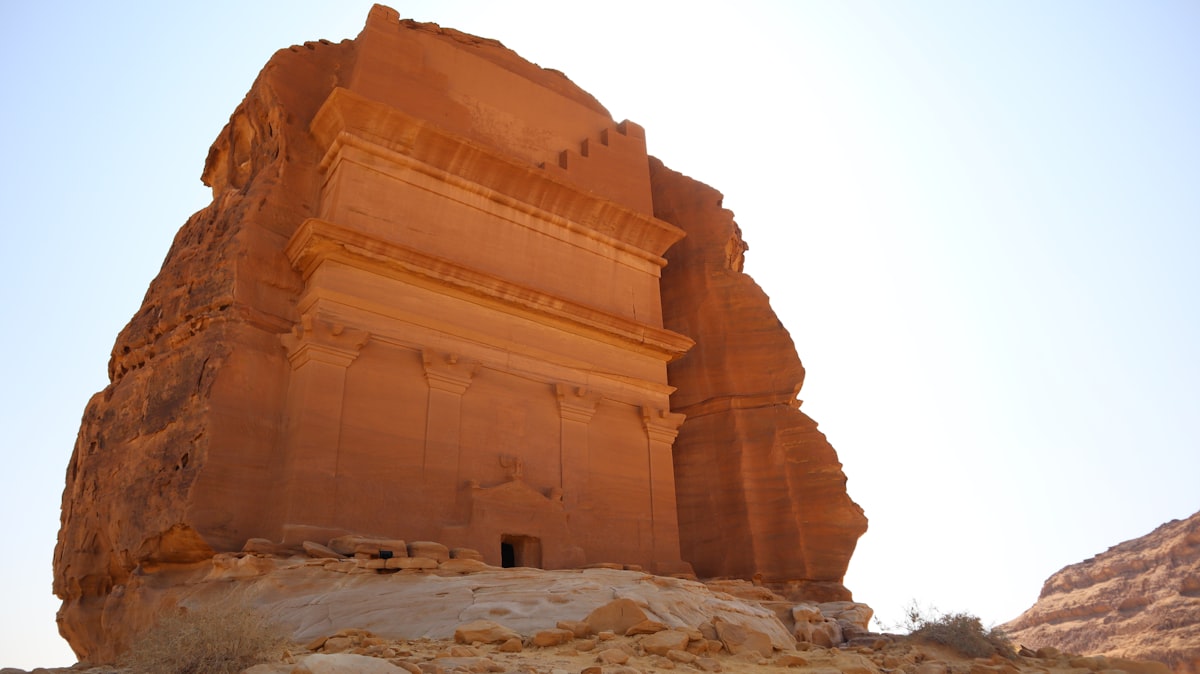
There is a tomb at Hegra that the masons never finished. Qasr al-Farid, the lonely one, stands by itself in the open, cut into a single outcrop of rose sandstone, and its lower third is still rough, chiseled but unsmoothed, because the Nabataeans worked a facade downward from the top and this one was abandoned before they reached the ground. You can read the method in the stone: the finished cornice above, the unresolved base below, the whole thing a lesson in how a monument is made, left open by accident. It has stood that way for roughly two thousand years. What is new is that someone is now selling tickets to see it.
Hegra, the old Mada'in Salih, sits in the AlUla valley in the northwest of Saudi Arabia, about three hundred miles south of Petra. It was the Nabataeans' southern city, the second after their capital, and the two places are the same civilization in the same pink rock, tombs carved into cliffs by caravan traders who grew rich on frankincense and then vanished into Rome. In 2008 UNESCO inscribed Hegra as Saudi Arabia's first World Heritage Site: a hundred and eleven monumental tombs, ninety-four of them with decorated facades, and some fifty older inscriptions cut into the walls before the Nabataeans arrived. Petra has more than six hundred tombs and, on Jordan's tourism figures, took in close to a million visitors in just the nine months to September 2023. The whole AlUla valley, Hegra included, drew around 286,000 across all of 2024, and only 28 percent of those came from outside Saudi Arabia and the Gulf. Those are the Royal Commission for AlUla's own numbers, which makes the body counting the visitors the same body selling the place. Even setting Petra's nine months against the valley's full year, Petra outdrew AlUla several times over. That gap is the whole pitch.
The pitch has a name, more or less: the quieter Petra, the little sister, the one you can still have almost to yourself. It is a real thing to want, and it is also a marketing position, and the two are not separable. The commission ran an international campaign across ten countries, from Britain and Germany to China, India and Australia, and it wants 1.2 million visitors a year by 2030, up from that near-empty base, while insisting the growth stays managed. Its marketing director, Melanie de Souza, told the trade outlet AGBI that the commission is "not about mass tourism," and that the value of foreign visitors is "a longer length of stay and therefore a better yield." This is a place watching Petra's crowds and Venice's fees and choosing, on paper, to arrive slowly.
What makes it unusual is that you can see the arrival being built. Saudi Arabia opened to non-pilgrim tourists only in September 2019, with its first tourist e-visa; before that a Western traveler simply could not go. The airport at AlUla handles 400,000 passengers a year now and, on the commission's account, is being enlarged toward six million by 2030, with new hotels going up under the names you would expect, Banyan Tree and Habitas, and a Hyatt and a Marriott to come. Most destinations were made slowly, by accident, over centuries of people showing up. This one is being drawn, funded and scheduled, and you are invited to visit the drawing while the ink is wet.
Which is where the honest part begins, the part a traveler weighs in the quiet before booking. The Royal Commission for AlUla was created by royal decree in 2017 under the chairmanship of Crown Prince Mohammed bin Salman. In February 2021 the United States director of national intelligence assessed, in a declassified report, that the same crown prince "approved an operation in Istanbul, Turkey to capture or kill Saudi journalist Jamal Khashoggi," who was killed inside the Saudi consulate there in 2018; the kingdom rejected the assessment as false.
Saudi Arabia's record runs past that one case. Amnesty International recorded 345 executions in Saudi Arabia in 2024, the most it has counted there in more than three decades, roughly a third of them for drug offenses, and 180 more in the first half of 2025. Human Rights Watch notes that the 2022 Personal Status Law formally enshrines male guardianship over women, even as women over 21 have, by the same group's account, been able since 2019 to hold a passport and travel without a man's permission. None of this is my discovery; it is the public record, and it does not stay outside the gate when you go in.
The cultural building is part of the same account. France signed a ten-year agreement to develop AlUla with the crown prince in 2018, a Pompidou museum is planned for the valley, and the Desert X art fair has staged installations there with the commission he chairs. The Art Newspaper and other art-press outlets have reported the charge that Vision 2030 uses heritage and culture to launder an image; I will not pretend to settle that here. There is a thing tourism likes to say about places like this, too, that the locals were moved to make way. I cannot find reporting that shows it here: the relocation on record is the voluntary departure from AlUla's mud-brick Old Town in the 1980s, and the Old Town now stands restored.
I have been wrong before about the future of a place, and I have learned to stop predicting whether a place will stay unspoiled or become good. So I will not tell you whether to go, or whether the quiet will hold once 1.2 million people a year come to buy it. I will tell you that the unfinished tomb is still there, its base still rough, waiting on masons who put down their tools before Rome finished the job, and that whatever a state decides to make of the valley around it, the stone keeps its own indifferent time.