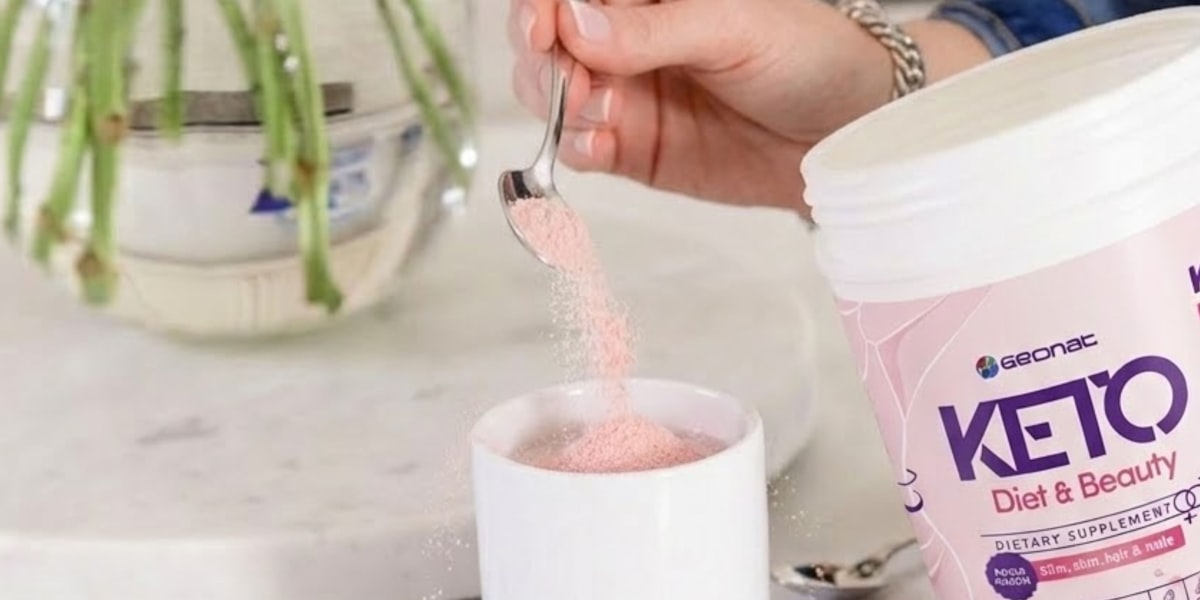
"Beauty from within." That is the phrase on the powder tub, the gummy pouch, the coffee creamer dosed with hydrolyzed peptides. It is a good line because it is unfalsifiable: within where, measured how, at what dose. This year the literature has caught up enough to answer some of it. Collagen does something, though what and for whom is exactly the fight. The box overpromises for two reasons. The smaller: the effect it can prove is not the effect it sells. The larger, and the spine of this piece: the skin benefit shows up mostly in the trials that industry paid for.
The win is a lab reading, not your wrinkles
Start with the biggest pooled analysis so far, a review that combines many separate trials into one picture. In January 2026, an Anglia Ruskin University team published an umbrella review in Aesthetic Surgery Journal Open Forum, stacking 16 systematic reviews: 113 randomized controlled trials, 7,983 people. The headline for skin is genuinely positive. Collagen showed a clear improvement in skin elasticity and a smaller but still real gain in hydration, both big enough to count as moderate-to-large by the usual yardstick (effect sizes of about 1.0 and 0.7, across 20 and 19 high-quality trials). The catch is in one word the box would never print: "standardized." These are instrument readings, a cutometer pulling at your cheek, a probe measuring water in the top layer of skin. They are not counts of visible wrinkles.
That is the first reason the box overpromises. In the same review, skin roughness, what most people actually mean by wrinkles, showed no proven effect at all. The average pointed toward improvement, but the spread of results was wide enough to still include zero, which is the careful way of saying the review could not rule out that collagen does nothing for wrinkle texture (a standardized change of about -0.7, with a range that crossed zero). So the measurable win is in a lab probe reading of superficial skin, not in the mirror. The authors say as much. In the university's statement announcing the review, Lee Smith, the public-health professor who co-wrote it, called collagen "not a cure all, but it does have credible benefits when used consistently over time, particularly for skin and osteoarthritis." The lead author, Roshan Ravindran, was blunter in the same release: "benefits are real but not universal, and marketing often runs ahead of the evidence."
I want to be fair to the modest wins, because I have a habit of underselling things that work. The arthritis signal in that review is real: a genuine reduction in joint pain, small in size but steady enough across the trials to believe (a standardized pain reduction of about -0.35 across 25 trials, high certainty). There are honest gains in lean mass and strength too. The joint case is arguably stronger than the skin case, but collagen is not sold for knees. It is sold in blush-pink tubs next to the serums, and the skin promise is the one carrying the price.
The skin benefit tracks who funded the trial
The umbrella review pools other people's trials, and it flags the problem itself: many of the underlying meta-analyses were rated low or critically low quality, with unregistered protocols and a real risk of publication bias. The sharpest demonstration came eight months earlier, in May 2025, in the American Journal of Medicine. Seung-Kwon Myung and Yunseo Park pooled 23 trials and 1,474 people, and across all 23, collagen improved hydration, elasticity, and wrinkles. Then they split the pile. Trials funded by pharmaceutical or supplement companies showed the effect. Trials not funded by industry showed none. The same thing happened when they split by quality: high-quality studies, no significant effect; low-quality studies, effect. Their conclusion is worth quoting flat: "There is currently no clinical evidence to support the use of collagen supplements to prevent or treat skin aging." Their own paper took no industry money and declared no conflicts.
That is a harder claim than the umbrella review's, and it is contested. GROW, the Gelatin Manufacturers of the World, put out a formal statement in August 2025, reported by the trade outlet NutraIngredients, calling the split overdrawn: most of the 23 trials had some commercial involvement, a few studies counted as independent had quiet affiliations, and "funding alone does not compromise scientific integrity when proper methodology and peer review are followed." That last point is true. Money does not falsify a cutometer. But the pattern is the uncomfortable kind: exactly what you would see if the effect were partly an artifact of who designed the study, which peptide and dose they used, and which results got published. Anyone who has read enough asterisks learns to be nervous when the benefit tracks the invoice.
A third review lands in the same territory, and it is the easiest one to read without a statistics degree, because it just counts trials. A 2026 systematic review in the European Journal of Clinical Nutrition read 25 hydrolyzed-collagen trials and tallied the wins: among the trials that measured each thing, hydration improved in 10 of 15, elasticity in 10 of 13, wrinkle measures in 9 of 10. Impressive on its face, yet the authors open by calling the evidence "inconsistent." These are not three independent verdicts. The umbrella review and the Myung and Park analysis draw on an overlapping pool of the same trials and genuinely disagree: one rates the elasticity signal high certainty, the other says it disappears once you account for who paid. The European review, tallying rather than pooling, just calls the body of work uneven: something real, modest, form-specific, and entangled with its funders.
So where does that leave the pink tub of powder you were thinking of buying. My read: hydrolyzed collagen, at the doses these trials used, typically a few grams a day over two to three months, is a low-risk thing that probably nudges a probe reading of your skin's elasticity and hydration, may help your joints more than your face, and will not iron out a wrinkle the way the box implies. It is not toxic, it is not a scam, it is not a cure. It is a supplement with a modest, honest effect wearing a claim two sizes too big. And the most reliable answer here is still the one nobody markets: what the independent trials found when nobody was paying for it.