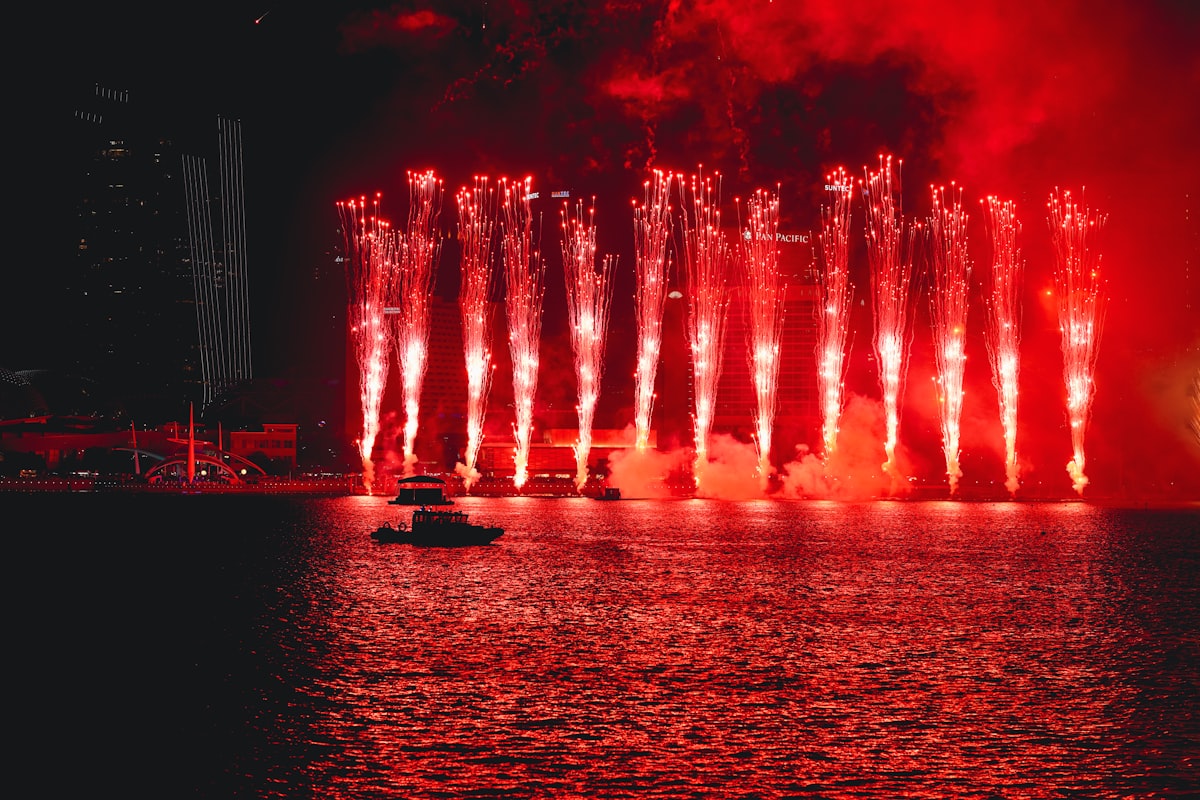
10:30 p.m. on a Saturday night in June, and the whole of Funchal is looking the same direction. Not at a stage, not at a screen. At the water. The Avenida do Mar is a solid wall of people from the marina to the cathedral end, kids up on shoulders, old women in folding chairs they carried down from Santa Maria, the cafe waiters standing in their doorways with trays going cold. Then the first shell goes up off the pier, and twenty thousand phones come up with it, and for the next twenty minutes nobody in this city is doing anything else.
This is the Festival do Atlântico, and its beating heart is the Madeira International Fireworks Competition. The setup is simple enough that you can explain it to the person next to you while the smoke clears: on the first three Saturdays of June, one country each takes the bay for a single pyromusical show, roughly twenty minutes, choreographed to music, fired off the Cais do Funchal, the town pier, at 10:30 p.m. so the whole amphitheater of the town can see it. The fourth Saturday, Portugal closes the thing out with an honorary show and does not compete. Three contenders, three nights, one bay. Per the island's tourism board, that has been the shape of it for years.
Here is the part that makes it more than a nice night out. The June contest is an audition. The real prize, historically, has been the right to help stage Funchal's New Year's Eve display, which is not a small thing to win: on 31 December 2006 Madeira put 66,326 fireworks into the sky from 37 launch sites and, as Guinness World Records recognized it, staged the largest firework display on earth, a title the island held until Kuwait beat it in 2012. So the summer competition is the qualifier and the December show is the final. That is also, if you believe the local telling, why the invitation has been a hard sell over the years: the reporting is that plenty of invited countries have quietly declined, because the cost of shipping and firing a world-class show over an ocean is genuinely insane.
The jury and the crowd split the prize
Who actually shows up. This year, per Events Madeira's running order, it was Canada on 6 June, China on 13 June, Ukraine on 20 June, then Portugal's closing show on the 27th. And here is where I stop being neutral, because the judging is the best thing about this festival. There are two trophies. One, the Atlantic Trophy, is handed out by a jury. The other, the Madeira Tão Tua trophy (roughly, "Madeira belongs to all"), is decided by the public: you drop a vote in a ballot box at the Plaza Madeira shopping center, at the tourist office on Avenida Arriaga, or at the pier on the night. The crowd gets a real say. The crowd is the point.
And the crowd and the jury split it. The Madeira daily Diário de Notícias da Madeira reported the jury's Atlantic Trophy went to China's Nanchang Fireworks Industries, while the public's trophy went to Ukraine's team, Dance of Fire. Canada took neither. I did not see the Ukrainian show in person, but I have watched enough rooms vote against the experts to trust the instinct: a jury scores technique, a bay full of people scores the thing that made them gasp, and those are not always the same show.
The money is real, the round numbers are not
None of this is cheap or accidental. At the festival's launch the same paper put this year's budget around 509,000 euros, up more than 10 percent on last year, mostly on the rising cost of flying the competition in. And do take the rounder numbers with a grain of salt: the tourism sites will tell you the contest was "born in 2002" and pulls "over 120,000 people" every June, and those figures get copied from page to page without anyone showing their working. It is a regional government spending real money to fill hotel rooms in the shoulder of summer, and it does not pretend otherwise.
The whole bay is the ticket, no plan required
If you actually want to stand there for it, you do not need much of a plan. The shows run three Saturdays straight, 10:30 p.m. sharp, and the whole bay is the ticket: walk the Avenida do Mar for the classic view and expect to fight for a spot, climb to the Pontinha pier or one of the hillside miradouros above the harbor for the same sky with room to breathe, or pay someone with a boat to take you out on the water and let it come down around you. The tourism board has already locked in next year, June 4 through 27, 2027, same shape, three competing Saturdays and Portugal's honorary close on the fourth. And if one night is not reason enough to book the flight, the wider festival gives you an excuse to stay the month: a preliminary pyromusical out in Machico Bay the Friday before Funchal even starts, the same format sent out to Porto Santo's old pier in Vila Baleira later in June, and an opera night up at the São João Baptista fortress on Pico for the evenings the sky over the bay stays dark.
You cannot buy a better seat, because nobody sells one
But here is the thing I keep coming back to, and it is why I would put this above half the ticketed festivals I cover. It is free. There is no wristband, no five-tier VIP deck, no velvet rope on the water. You cannot buy a better seat than the one you can just walk up and take, because nobody is selling one. I spend most of my year watching cities work out how to charge you for the good nights. Funchal, for three Saturdays in June, hands them back for nothing: the broke twenty-two-year-old on the seawall, the widow in her folding chair, the kid up on his father's shoulders, all of them get the same bay, the same twenty minutes, the same last bang rolling back off the mountains a half-second late.