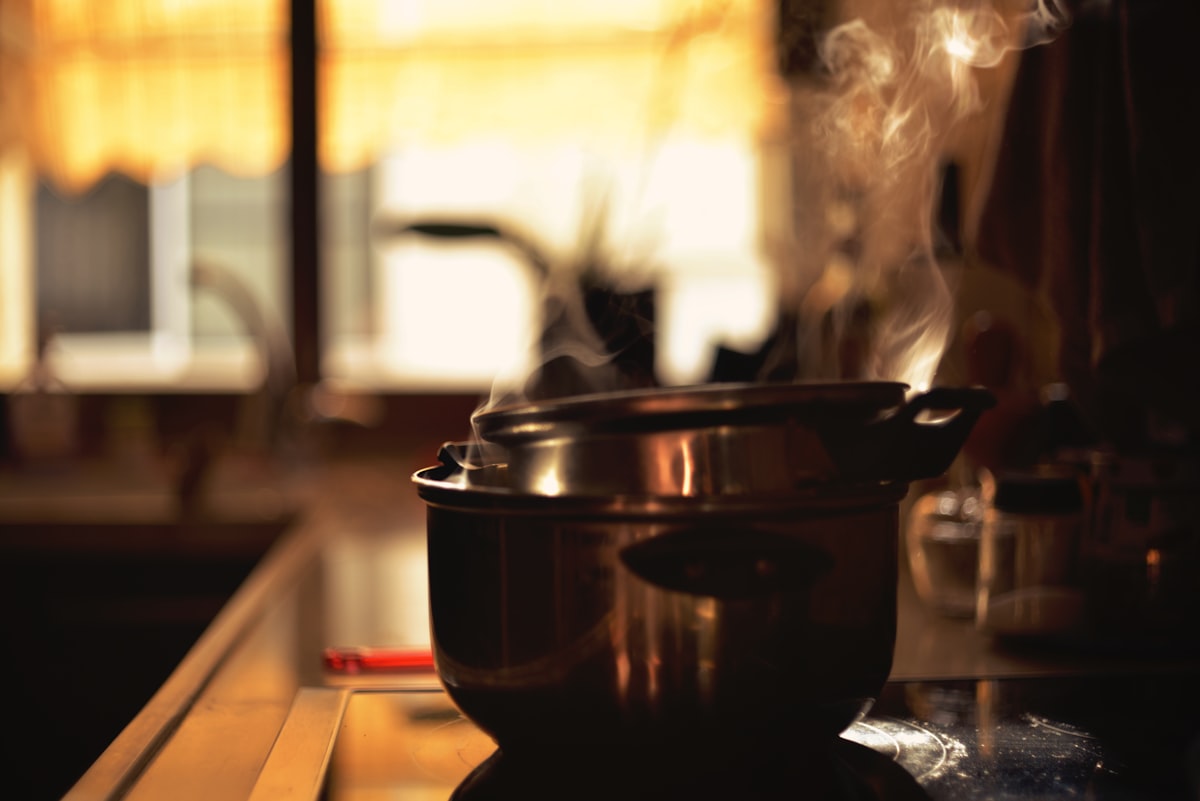
There is a chicken in my fridge tonight on its third act. It went into the oven on Sunday as a roast, came out on Monday shredded into a thing I called a pie mostly to stop the children arguing, and tonight the bones are in a pot with an onion and the sad end of a bunch of parsley, becoming the kind of soup that tastes of thrift and Sunday and a bit of regret. My grandmother would have recognized every stage of it. She would also have wondered why I was so pleased with myself, since to her this was not a lifestyle, it was Tuesday.
I have been reading American grocery numbers from my Lisbon kitchen for a few weeks now, which is a strange thing to admit is a hobby, and they tell a story I keep wanting to make prettier than it is. The story people are telling themselves is that the home cook is back, that families are rediscovering the stove, that there is something wholesome afoot. The truer version is quieter and a little sadder. The kitchen did not win an argument. It won by default, because the other door got too expensive to keep walking through.
The kitchen won by default, not by argument
Here are the two numbers that do the work. The US Department of Agriculture, in the June 25, 2026 update to its Food Price Outlook, expects prices for food eaten away from home to rise 3.6 percent this year, and prices for food bought at the grocery store to rise 2.8 percent. That gap looks small written down. Live inside it for a few years, which Americans have, and it compounds into a wall. Restaurant prices are now forecast to climb faster than their own twenty-year average while grocery prices climb slower than theirs, and the government's own economists describe the result in the flattest possible terms: it is becoming relatively more expensive to eat out, and relatively less expensive to eat in.
The National Restaurant Association, reporting on its 2026 State of the Restaurant Industry outlook, found 40 percent of consumers already cutting back on how often they go, and more than 60 percent of operators saying foot traffic softened last year. Its chief economist, Chad Moutray, called success this year a matter of getting the math right. That is a polite way of saying people did the math and stayed home.
So the roast chicken is not nostalgia. It is a spreadsheet with skin on. And nothing tells you that faster than the strange American institution of the Costco rotisserie chicken, which has held at 4.99 dollars since 2009, going on seventeen years, pinned there on purpose while everything around it inflated. Costco sells it at a loss. On a 2015 earnings call, reported by Fox Business, its longtime finance chief Richard Galanti said the company was willing to eat thirty or forty million dollars a year in gross margin to keep the price where it is, and that, he said, is what Costco does for a living. It sits at the back of the store, past the wine and the televisions, because, as John Longo of Rutgers Business School put it, very few people simply buy the chicken and leave. That bird is the load-bearing beam of a certain kind of American week. You buy it for less than a sandwich costs, and you make it be dinner, and then lunch, and then, if you are your own grandmother, soup.
People cook smaller when the money is tight
What I find more telling than the thrift is what the thrift does to the cooking itself. When money gets tight, people do not just cook more, they cook smaller. In figures from the Food Industry Association, FMI, surfaced by IFT's 2026 trends roundup, comfort food topped the list of meal priorities across every generation, named by 55 percent of those FMI surveyed, ahead of everything including how fast a thing is to make. A quarter of shoppers overall, and 40 percent of Gen Z, told the same researchers plainly that they do not have the money to experiment. That last phrase stopped me. Experimentation, the trying of the unfamiliar thing on a Wednesday, turns out to be a small luxury, and it is the first one to go. You retreat to the dishes you cannot get wrong. Store-brand pasta, the chicken again, the soup. Private-label grocery sales hit an all-time high last year, a record 282.8 billion dollars, which is the least romantic sentence I can offer you and possibly the truest.
The egg relief never reaches the dinner plate
Here is the cruelty in the detail, the part that keeps the whole thing from being a feel-good story about families gathered round a pot. The relief you keep hearing about barely reaches the plate. Yes, eggs have crashed. As of the May 2026 inflation figures they were down more than 35 percent from a year earlier, a dozen back to around 2.19 dollars, after that ugly avian-flu spring in 2025 when the average dozen touched roughly six. But beef, which is what most families actually build a dinner around, is at record highs: in that same May reading, up nearly 13 percent over the year, with a decent steak passing 13 dollars a pound. David Ortega, a food economist at Michigan State, put it better than I can, speaking to Marketplace: the drop in egg prices, he said, has been offset by the rise in beef prices, because the average American family spends about five times more on beef than on eggs. The cattle herd is the smallest it has been since the 1960s, and as Phil Lempert, the analyst who writes as the Supermarket Guru, noted in the same piece, it takes about two years from a calf being born to the meat reaching a shelf, so this is not a thing that fixes itself by autumn. The good news and the bad news are in the same basket, and the bad news weighs more.
None of which has dented the commitment, at least by the industry's own account. HelloFresh's home-cooking survey found 93 percent of American households planning to cook the same amount or more this year, more than half of them naming saving money as the reason, and 68 percent admitting they had skipped buying something they usually get because the price had gone too far. Take that 93 percent with some salt: HelloFresh sells meal kits, so a survey finding that everyone means to cook more is a survey finding that happens to flatter its business, and stated intentions are a soft measure at the best of times. Planning to cook as much or more is not the same as doing it. But the direction of it squares with the harder grocery data, which is why I half believe it. You can read the number as defeat. I read it, most nights, as the thing my grandmother knew, which is that a household run from its own kitchen is more stubborn than the prices set against it. The stove is where you take back a little control when nothing else will give you any.
I do not want to make this come out neat, because it does not. The kitchen won because the restaurant priced itself out of an ordinary Friday, and calling that a renaissance is the sort of flattery we tell ourselves so the compromise feels chosen. But I will say this from the far end of a week I have eaten one chicken through. The secondhand cookbooks I collect are full of other women's margin notes, and the best of them are not the recipes for feasts. They are the small, penciled adjustments beside the plain dishes, halve this, stretch that, use the bones, made by people who were also doing math they would rather not have been doing, and who fed everyone anyway. The soup is nearly ready. It is only soup. It will do.